Professional services agreement (MSA) template
A master service agreement for firms that do client work: the Key Terms fix the legal deal once, and a statement of work covers each project's scope, fees and dates.
- Common Paper 1.1 · lawyer-written
- Free to use
Loading PDF preview…
When should you use a professional services agreement?
Use it when your firm will do repeat work for the same client, such as agency retainers, consulting, or implementation and development projects. You sign the legal terms once, then add a statement of work per project.
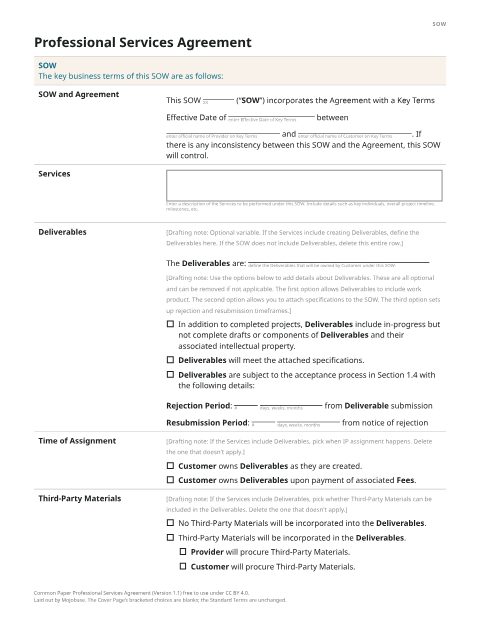
The file opens with the first statement of work, then the Key Terms cover page, then Common Paper's Professional Services Standard Terms version 1.1, written by a committee of attorneys. Key Terms override the Standard Terms, and anything they leave out reads as "none".
Other templates fit better when the client buys access to your software (cloud service agreement), tries a product first (pilot agreement), or when you hire one freelancer yourself (independent contractor agreement).
What does this professional services agreement cover?
The Standard Terms run to 13 sections. In order:
- Services (1)
- Each SOW forms a separate contract. The customer cooperates, changes go through written change orders, and deliverables can face a reject-and-resubmit process. Subcontractors need the customer's permission, and the provider answers for them.
- Intellectual property (2)
- Deliverables pass to the customer at the time the SOW sets. The provider keeps its pre-existing materials and licenses them for use inside the deliverables. Third-party materials go in only if the SOW allows.
- Privacy, security, payment and taxes (3, 4)
- A signed DPA controls personal data, and the provider follows any named security policy. Fees are in U.S. Dollars unless the SOW says otherwise and non-refundable apart from prorated refunds on some terminations. A disputed invoice is flagged within the payment period, with the rest paid on time.
- Term and termination (5)
- It lasts until 12 months after the last SOW ends. Either side can end it for a breach unfixed after 30 days, for insolvency, or for any reason once no SOW is active, and can end one SOW after 30 days of force majeure.
- Warranties (6, 7)
- The provider promises professional work and non-infringing deliverables that match the SOW. If they don't match, the customer reports it within 45 days and the provider redoes the work, or the customer ends the SOW for a prorated refund.
- Liability, indemnity and insurance (8, 9, 10)
- Liability stops at the General Cap Amount, or a higher cap for listed Increased Claims, with no cap for Unlimited Claims. Each side defends the other against third-party claims on its Covered Claims list. Insurance minimums last for the term and six months after.
- Confidentiality and general terms (11, 12, 13)
- Confidentiality is mutual. Customer purchase order terms don't apply, neither side announces the deal unless the Key Terms grant publicity, and force majeure never excuses payment. Section 13 defines the capitalized words.
How do you fill in the professional services agreement?
Required: both legal names, the first project's services, fees and payment period, the governing law and the courts. Empty optional rows don't apply.
- The first statement of work (pages 1 and 2)
- The SOW number, Key Terms date, names, services, deliverables and acceptance periods, when ownership passes, third-party materials, fees, invoicing, dates and customer obligations. Changes written here apply to this project alone.
- Start date, governing law and courts
- The last signature starts the agreement unless you tick a set date. Then the state or country whose law governs, and where disputes are filed.
- Cap as a multiple, a dollar amount, or the greater of two
- Pick one. A multiple applies to fees paid or payable in the 12 months before the claim. Leaving every option empty means no limitation of liability.
- Higher-cap and no-cap claims
- Tick the claims that get a bigger limit, often called a supercap, from privacy and security breaches, confidentiality breaches, indemnification and gross negligence, then set that cap the same three ways. Tick any claims that have no cap at all from the same list.
- Extra promises and insurance
- Warranties either side adds on top of section 6. For insurance, tick each policy type for the provider or customer with per-occurrence and aggregate minimums, and which policies name the other side as additional insured.
- Data, policies, security and publicity
- Where to find a DPA and any customer policies, the provider's security policy, and the yearly reports it keeps, such as SOC 2 Type II. Then whether the provider may show the customer's logo, or only name it privately to investors and advisors.
- Changes for all projects
- Any change to the Standard Terms that applies to every SOW, then the company names above the signatures.
Which documents go with a professional services agreement?
It sets the legal frame for client work. These fill it in or sit beside it.
- Statement of work
- The second and later projects each get one, tied to this agreement by its Key Terms date.
- Data processing agreement
- Named in the Key Terms when the work touches the customer's personal data, and it controls that data.
- Mutual NDA
- Covers what both sides share while scoping the work, before this agreement and its own confidentiality section are signed.
- Independent contractor agreement
- For bringing in one freelancer to help deliver, where you are the one hiring.
- Cloud service agreement
- When the client is subscribing to software you run, not paying for services.
- Contract amendment
- Changes the Key Terms or Standard Terms after signing, which section 12.2 requires in writing.
What else do people ask?
Is a professional services agreement the same as a master service agreement?
In use, yes. This one works the way people mean by an MSA: one signed set of legal terms between a provider and a customer, with a separate statement of work for each project. Its definitions make that explicit, since each SOW together with the Key Terms and Standard Terms forms its own agreement, and the whole relationship lasts until 12 months after the latest SOW ends.
Does this MSA limit liability?
Only if you fill in a General Cap Amount. The Key Terms offer three forms: a multiple of the fees paid in the prior 12 months, a dollar amount, or the greater of the two. The drafting note says that deleting the row leaves the agreement with no limitation of liability. Separate rows can raise the cap for listed claims or remove it entirely for others.
Who owns the deliverables under this agreement?
The customer, from the Time of Assignment set in each SOW: as the deliverables are created, or once their fees are paid. Two things stay with their owners: the provider's pre-existing materials, which the customer gets a permanent license to use within the deliverables, and third-party materials, licensed by whichever side the SOW says obtains them.
Can the provider list the customer as a client?
Not by default. Section 12.7 bars either side from announcing the agreement without written approval, and its existence counts as confidential information. The Key Terms offer two choices: the provider may use the customer's name and logo on its website and in marketing during the agreement, or name the customer only in private settings such as talks with investors and advisors.