SaaS agreement template (cloud service agreement)
Common Paper's Cloud Service Agreement 3.0 sets the terms for selling hosted software: an Order Form for each subscription, Key Terms for the legal choices, and Standard Terms.
- Common Paper 3.0 · lawyer-written
- Free to use
Loading PDF preview…
When should you use a SaaS agreement?
Use it when your business sells access to software it hosts and the customer logs in to use it for its own internal business purposes.
- Selling a subscription
- The customer pays per year, month, user or another unit, and the subscription renews unless one side gives notice in time.
- Opening with a pilot
- An optional pilot row gives a few months of access, paid or at no charge, and the subscription starts when it ends.
- Several orders over time
- The Key Terms are signed once, and each later purchase is a fresh Order Form under them.
- When it fits less well
- Software installed on the customer's own machines needs license keys and a deletion procedure, which the software license agreement has.
What does this cloud service agreement cover?
Two cover pages (the Order Form and the Key Terms) hold the choices. The Standard Terms version 3.0 follow in thirteen sections.
- 1. Service
- The customer uses the service for internal business purposes and answers for its users' accounts. The provider may use feedback freely and share usage data only aggregated and anonymous.
- 2. Restrictions & Obligations
- No reverse engineering, reselling, security testing or building a rival product. Access can be suspended over a balance unpaid for more than 30 days.
- 3. Privacy & Security
- Before uploading personal data that GDPR governs, the customer signs a data processing agreement, which then controls that data.
- 4. Payment & Taxes
- Fees are in U.S. dollars, exclude taxes and are non-refundable outside prorated refunds. A disputed charge is raised before it falls due.
- 5. Term & Termination
- Orders renew each Subscription Period. Either side may end one after a breach left uncured for 30 days, insolvency, or a 30-day force majeure outage. On request, customer content is deleted within 60 days.
- 6 and 7. Warranties and disclaimer
- The provider promises not to materially reduce the service's general functionality, with 45 days to restore it or a prorated refund. Everything else is disclaimed.
- 8. Limitation of Liability
- Liability stops at the General Cap Amount and indirect damages are waived, except for confidentiality breaches, gross negligence, willful misconduct, fraud and the Key Terms' carve-outs.
- 9 and 10. Indemnification and Confidentiality
- Each side defends the other against its Covered Claims and protects the other's confidential information with at least reasonable care.
- 11 to 13. Rights, General Terms, Definitions
- The provider keeps the product and the customer its content. Beta products come as is, and the provider may show the customer's logo in marketing.
How do you fill in the cloud service agreement?
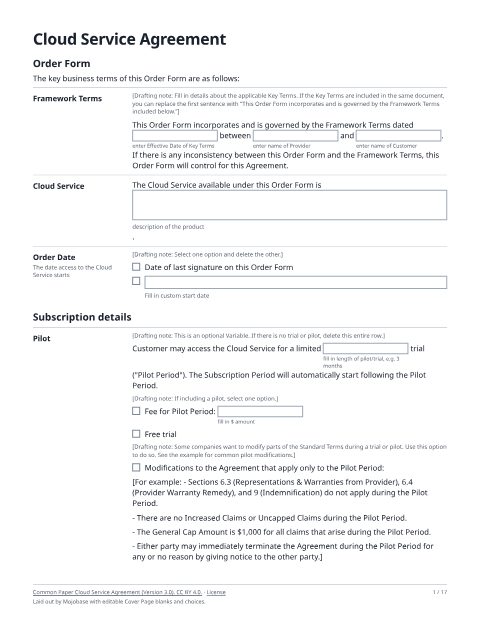
Fill in the Order Form for this purchase, then the Key Terms for the whole relationship. Each cover page has its own signature block.
- Key Terms date and names
- Link the Order Form to the Key Terms by their date and the two parties' names.
- The cloud service and access start
- Describe the product. Access begins at the last signature or on a date you set.
- Pilot
- Optional: a length, then a fee or no charge, plus any terms that change only during the pilot.
- Subscription and fees
- Give the length, such as 12 months, and a fee per unit or another structure. Optional boxes cap or fix renewal increases, or make fees include taxes.
- Payment and renewal
- Invoices go out at a chosen cadence with a number of days to pay, or the card on file is charged. Set the days of notice that stop renewal, or tick that the order expires.
- Support, services and order changes
- Describe support, then point to an SOW or PSA or describe the services and their billing. The last box takes changes for this order only.
- Law, courts and covered claims
- Name the governing state or country and where the courts sit. Tick the provider's IP indemnity, the customer's content indemnity, or both.
- Caps and uncapped claims
- Each cap is a multiple of the last 12 months' fees, a dollar figure, or the greater of both. The supercap covers the claims ticked under it; uncapped claims escape both.
- DPA, security and insurance
- Say where the DPA is, pick the security promise, and give per-occurrence and aggregate minimums for each insurance policy ticked.
Which related document do you need?
A SaaS deal often needs a document for personal data, one for project work, or one for talks before signing.
- Data processing agreement
- Section 3.1 asks for one before GDPR personal data reaches the service.
- Software license agreement
- Pick it instead when the customer runs your software on systems it controls.
- Pilot agreement
- A standalone evaluation, signed before anyone commits to a subscription.
- Statement of work
- Attach one in the Professional Services row for onboarding or integration work.
- Mutual NDA
- Covers roadmaps, pricing and security answers swapped during the sale.
- Contract amendment
- Records a later change to a signed Order Form or the Key Terms.
What else do people ask?
What is the difference between the Order Form and the Key Terms?
The Order Form holds one purchase: the product, start date, pilot, subscription length, fees, payment and renewal. The Key Terms hold the legal choices for the whole relationship: law, courts, indemnities, liability caps, security and insurance. The Key Terms are signed once, and each new purchase is a new Order Form under them.
Does a SaaS agreement renew automatically?
This one does by default. Section 5.1 renews each Order Form for another Subscription Period unless one side gives notice of non-renewal before the Non-Renewal Notice Date, a number of days before the period ends. A box on the Order Form turns renewal off, so the order expires instead.
Can the provider use the customer's name and logo?
Yes. Section 12.8 lets the provider name the customer and use its logo in marketing as a user of its products. No box on the cover pages turns this off, so a customer who wants it gone or limited writes that into the changes to the Standard Terms before signing.
What happens to customer data when the agreement ends?
The customer can no longer use the product. If the customer asks, the provider deletes customer content within 60 days. Each side returns or destroys the other's confidential information, and copies kept in normal backups stay protected. The provider then sends a final invoice for fees owed up to the end.