
Independent contractor agreement template
A one-page sheet sets what a freelancer will do and what you pay; ten sections of terms then give you the work product and keep the contractor independent.
Preview all 6 pages ›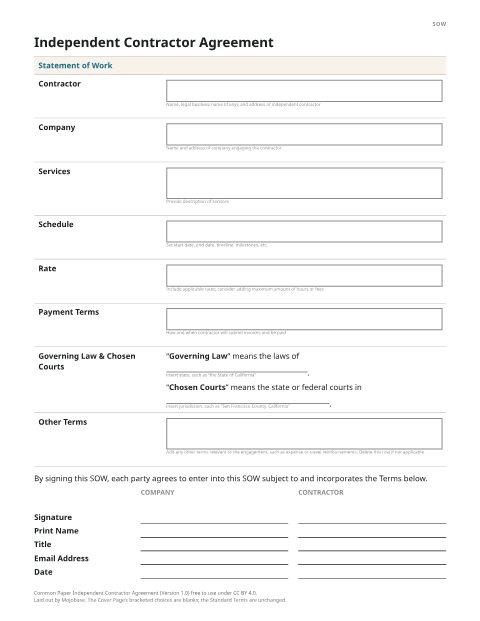
Loading PDF preview…
When should you use an independent contractor agreement?
Use it when your business brings in one person to do a defined piece of work, paid at a rate, who decides how the work gets done and stays off your payroll.
Typical cases: a freelance designer for a rebrand, a developer for a three-month build, a bookkeeper who closes the books each month. The document defines the contractor as an individual, and section 1.3 describes the services as outside your company's usual course of business.
Another document fits better when the person will work as staff under your direction (an employment offer letter), when your firm delivers services to a client (a professional services agreement), or when you only need to share plans before hiring (an NDA).
What does this independent contractor agreement cover?
A one-page cover sheet, which the document calls the SOW, holds the deal. Ten sections of terms and conditions follow it, in this order.
- Services and restrictions (1)
- The contractor performs the services on the cover sheet, changed only by written agreement. For the agreement's life and one year after, the contractor won't solicit your people. You give general direction; the contractor picks the manner and means and supplies their own insurance, materials and tools.
- Payment and taxes (2)
- You pay as the cover sheet says, and milestone payments wait until each milestone is done to your reasonable satisfaction. No expenses unless the sheet says so. You withhold no payroll taxes, the contractor gets no employee benefits, and they give you a W-9.
- Intellectual property (3)
- All work product is a work made for hire owned by your company, and anything that doesn't qualify is assigned to you. The contractor also waives moral rights.
- Term and termination (4)
- It runs while the services go on. Either side can end it for a material breach not fixed within 15 days, or insolvency; only your company can end it for any reason, on 30 days' written notice. At the end the contractor hands over all work, drafts included, invoices what's owed and refunds prepaid fees for work not done.
- Confidentiality (5)
- One-way, protecting your company: the contractor uses your information only for the job and guards it with at least reasonable care. You can seek an injunction without posting a bond.
- Representations, warranties and indemnification (6, 7)
- The contractor promises professional work, no conflicting commitments, non-infringing work product that matches the cover sheet, and the permits needed, and defends you against infringement claims, breaches of those promises, and harm from negligent or willful conduct.
- Limitation of liability (8)
- Written in your company's favor: the company owes no lost profits or indirect damages, and its total liability is capped at the fees paid or payable to the contractor in the 12 months before the claim. The section sets no cap on the contractor.
- General terms and definitions (9, 10)
- The contractor can't assign the agreement without your consent; your company can when it sells the business. Notices go to the emails on the cover sheet, and electronic signatures count.
How do you fill in the independent contractor agreement?
Every blank is on the first page, and the terms and conditions stay as written. The agreement takes effect on the date of the last signature.
- Contractor's name and address
- The person's name, any legal business name they work under, and their address.
- Company name and address
- The legal name and address of the business hiring the contractor.
- What the contractor will do
- A description of the services. Section 6.2 promises the work product will meet what is written here.
- Schedule and milestones
- Optional. A start date, end date, timeline or milestones. Milestones listed here become conditions of payment under section 2.1.
- Rate, and how and when you pay
- The rate, whether hourly, daily or per project, with any maximum on hours or fees. Then how the contractor invoices and when you pay, for example monthly invoices paid within 15 days.
- Governing law and courts for disputes
- A state written like "the State of California", and a place written like "San Francisco County, California". Disputes go to the state or federal courts there.
- Other terms
- Optional. Anything specific to this job, such as expense or travel reimbursement, which section 2.1 excludes unless it is written in.
- Signatures
- Each side signs with a printed name, title, email address and date. Those email addresses become the notice addresses under section 9.6.
Which documents go with an independent contractor agreement?
This agreement covers one person doing defined work. These documents sit beside it or replace it.
- Employee IP agreement
- The employee version of section 3: it assigns what your staff create at work to the company.
- Form W-9
- Section 2.2 asks the contractor for one so you can report what you paid them.
- Form W-8BEN
- What a contractor who is not a US person gives you in place of a W-9.
- Contract amendment
- To change the signed agreement later, which section 9.2 requires in writing signed by both sides.
What else do people ask?
Who owns the work an independent contractor creates?
Under this agreement, your company does. Section 3 treats all work product as a work made for hire owned by the company and, for anything the law doesn't treat that way, assigns it to the company outright, with patents, copyright, trade secrets and know-how. The contractor also waives moral rights and appoints your officers to sign ownership paperwork on the contractor's behalf, for that limited purpose only.
Can the contractor end the agreement early?
Only for cause. The right to end it for any reason on 30 days' written notice belongs to the company alone. The contractor can end it if the company fails to fix a material breach within 15 days of notice, breaches in a way that can't be fixed, stops doing business, or enters insolvency. Both sides can also end it at any time by written mutual consent.
Does signing this make someone an independent contractor?
The agreement records the relationship but doesn't settle it alone. Section 1.3 says the contractor isn't an employee or agent and controls the manner and means of the work, and sections 1.4, 1.5 and 2.2 put insurance, tools and taxes on the contractor. Tax agencies and courts also look at how the work happens day to day, such as who controls hours and methods.
What happens to confidential information when the work ends?
The contractor returns it or, if your company prefers, destroys it, under section 4.3. The duty to keep it secret continues afterwards, because section 4.4 keeps confidentiality alive along with intellectual property, indemnification, the liability limits and the one-year non-solicitation. The agreement's existence and the cover sheet's details count as confidential information too.