Free mutual NDA template
A two-way non-disclosure agreement: both parties can share confidential information, and each must use what it receives only for the agreed purpose and keep it protected.
- Common Paper 1.0 · lawyer-written
- Free to use
Loading PDF preview…
When should you use a mutual NDA?
Use a mutual NDA when both sides will hand over private information, so each needs the same promise from the other before talks go further.
- Partnership or joint product talks
- Two companies comparing roadmaps, customer lists or technology before deciding to build or sell something together.
- Vendor reviews
- A buyer shares its requirements and the vendor shares pricing and security and compliance documentation. The MNDA names all of these as Confidential Information.
- Before anything is agreed
- Section 11 says neither party has to disclose anything or go ahead with any transaction, so it can be signed at the first meeting.
- When only you share
- If the information flows one way, such as a prototype shown to a supplier, a one-way NDA binds only the recipient and only the recipient signs.
What does this mutual NDA cover?
It has a one-page Cover Page with your choices and eleven Standard Terms that Common Paper publishes, left unchanged here. Where the Cover Page and the Standard Terms conflict, the Cover Page controls.
- 1. Introduction
- Confidential Information is anything marked confidential or proprietary, or that reasonably looks it. Product designs, pricing and know-how are named, and so is the fact that the parties are talking.
- 2. Use and Protection of Confidential Information
- The receiver uses it only for the Purpose, shares it only with people who need to know and are bound to similar secrecy, and guards it as it guards its own, at no less than reasonable care.
- 3. Exceptions
- Four kinds of information are left out: anything public through no fault of the receiver, anything it rightfully knew already, anything it got from a third party without restrictions, and anything it developed on its own.
- 4. Disclosures Required by Law
- A subpoena or court order can require disclosure. Where the law allows, the receiver warns the discloser in advance and helps, at the discloser's cost, to keep the information protected.
- 5. Term and Termination
- The MNDA begins on the Effective Date and ends with the MNDA Term. Either party may end it early by written notice, for any reason, and the duty of secrecy carries on for the Term of Confidentiality.
- 6. Return or Destruction of Confidential Information
- At the end, or sooner on request, the receiver stops using the information and returns or destroys it. Routine backup copies may stay, still covered.
- 7. Proprietary Rights
- Each party keeps its rights in what it shares. Disclosure grants no license.
- 8. Disclaimer
- Information is shared as is, with no warranty of title, merchantability or fitness for a purpose.
- 9. Governing Law and Jurisdiction
- The chosen state's law applies, and any lawsuit goes only to the state and federal courts in the place named on the Cover Page.
- 10. Equitable Relief
- Because money may not repair a leak, the discloser can ask a court for an injunction as well as its other remedies.
- 11. General
- No assignment without consent, except in a merger or sale of substantially all assets. Changes and waivers must be signed in writing, and notices go to the Cover Page addresses.
How do you fill in the mutual NDA?
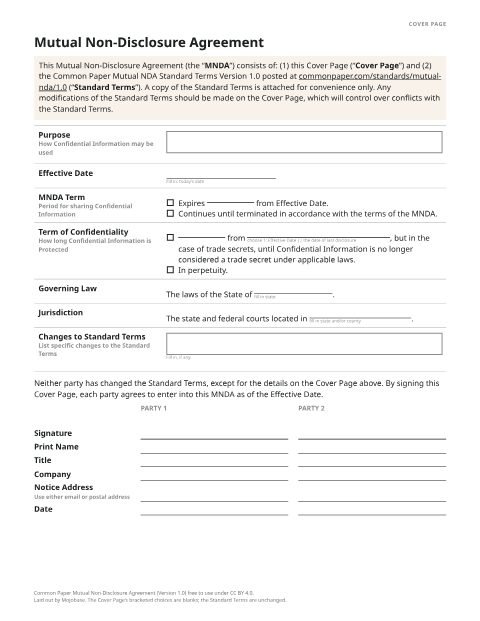
Every blank is on the Cover Page. The Standard Terms stay as published, and anything you change goes in the last box.
- Purpose of sharing
- What the shared information may be used for. The suggested words cover evaluating a possible business relationship with the other party; a named project or deal makes it narrower.
- Starts on
- The Effective Date, when the MNDA begins. It defaults to today.
- NDA ends after a set time, or runs until someone ends it
- Tick one to set the MNDA Term, the window for sharing information. A set time counts from the Effective Date, and you write its length in NDA lasts (1 year by default). The other choice keeps the window open until either party ends it by notice.
- Kept secret for a set time, or forever
- Tick one for the Term of Confidentiality. A set time runs for the period in Kept secret for, from the Effective Date or the date of the last disclosure (write which in Counted from). Trade secrets stay protected while the law treats them as trade secrets.
- Governing law (state)
- The name of the US state whose law governs the MNDA.
- Courts (state or county)
- The state, or the county within it, whose state and federal courts hear any dispute. Those courts have exclusive jurisdiction.
- Changes to the standard terms
- Leave it empty to accept the Standard Terms as published. Anything listed here overrides the matching term.
Which related document do you need?
A mutual NDA usually comes before the agreement that sets out the work, the product or the trial.
- One-way NDA
- Pick it instead when only your side discloses and only the other side needs to promise secrecy.
- Professional services agreement (MSA)
- For when talks become paid work: it sets the terms for the whole relationship.
- Statement of work (SOW)
- Under an MSA, each project's deliverables, dates and fees go in its own SOW.
- Contract amendment
- To record an agreed change after both parties have signed.
What else do people ask?
What is a mutual NDA?
A mutual NDA is a non-disclosure agreement in which each party may share confidential information and each must protect what it receives. Under this one, the receiving side uses the information only for the agreed Purpose, shares it only with people who need to know and are bound to similar secrecy, and returns or destroys it when asked.
Who wrote this NDA template?
Common Paper publishes it as its Mutual Non-Disclosure Agreement, Version 1.0, under the CC BY 4.0 license, and says it was written by a committee of attorneys. The Standard Terms in this PDF are unchanged from the published version, so you can compare them with the copy at commonpaper.com/standards/mutual-nda/1.0.
How long does a mutual NDA last?
Two periods matter. The MNDA Term is how long the parties may keep sharing information: either a set time from the Effective Date or until one side ends it by written notice. The Term of Confidentiality is how long received information stays secret: a set time or in perpetuity, with trade secrets protected while they remain trade secrets.
Can either side end the NDA early?
Yes. Section 5 lets either party end the MNDA at any time, for any reason or none, by written notice to the other. Ending it closes the window for sharing under the agreement, but the duty to protect information already received continues for the Term of Confidentiality chosen on the Cover Page.
Does signing a mutual NDA commit us to a deal?
No. Section 11 says neither party has any obligation to disclose Confidential Information to the other or to proceed with any proposed transaction. The MNDA governs only how shared information is used, protected and returned, which lets both parties sign it before they have decided anything about working together.