
Data processing agreement (DPA) template
Common Paper's Data Processing Agreement 1.1 sets how a provider processes a customer's personal data, with the EU and UK standard contractual clauses built in.
- Common Paper 1.1 · lawyer-written
- Free to use
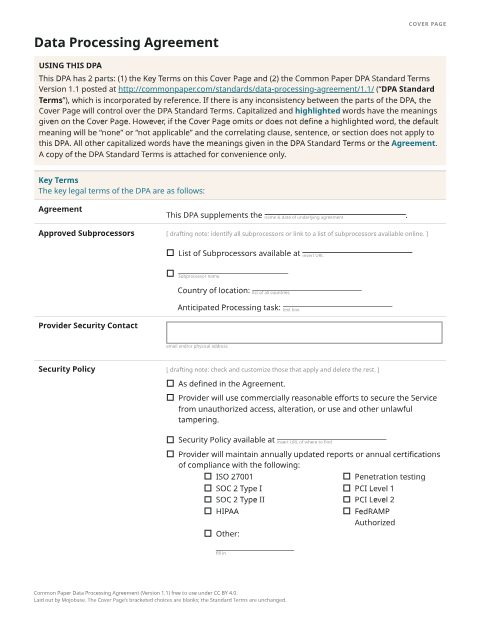
Loading PDF preview…
When should you use a data processing agreement?
Use it beside a main agreement whenever a provider handles personal data for a customer, such as software that stores the customer's users or staff records.
- Data from Europe or the UK
- It makes the provider a processor or subprocessor and fills in the annexes the EU standard contractual clauses and the UK Addendum need.
- California personal information
- An optional row confirms the provider acts as a CCPA service provider and won't sell or share the data.
- A customer's security review
- The cover page names a security contact, the yearly reports the provider keeps, and its technical measures, all in one place.
- When it isn't enough alone
- A DPA supplements an agreement and starts only once that agreement is signed, so the main deal needs its own contract.
What does this DPA cover?
A cover page of Key Terms and annexes comes first, then the DPA Standard Terms version 1.1 in eleven sections.
- 1. Processor and Subprocessor Relationships
- The provider is a processor when the customer controls the data, and a subprocessor when the customer is a processor for someone else.
- 2. Processing
- The provider follows the customer's instructions and says at once if it can't. New subprocessors are announced 10 business days ahead, and the customer has 30 days to object.
- 3. Restricted Transfers
- Where no adequacy decision covers a transfer out of the EEA or UK, signing counts as signing the EEA SCCs (Module Two or Three) or the UK Addendum. Swiss transfers are covered too.
- 4. Security Incident Response
- Notice of a breach without undue delay and within 72 hours of learning of it, then updates and steps to contain it.
- 5. Audit & Reports
- The customer checks compliance through the provider's audit reports and one written questionnaire a year. The provider keeps compliance records for 3 years after the DPA ends.
- 6. Coordination & Cooperation
- Regulator and data subject requests go to the customer before any answer, and the provider helps with impact assessments.
- 7. Deletion of Customer Personal Data
- The customer can delete data through the service. Afterward, the provider returns or deletes it as instructed unless the law requires keeping it.
- 8. Limitation of Liability
- The main agreement's caps apply, but not to individuals' data protection rights or SCC violations.
- 9 to 11. Conflicts, Term, Definitions
- The SCCs win over the DPA, and the DPA over the main agreement. Duties last until the provider stops processing the data.
How do you fill in the data processing agreement?
All the blanks sit on the DPA's cover page and its annexes. A choice left out means its clause doesn't apply, as the DPA's opening paragraph says.
- Main agreement
- Name and date the agreement this DPA supplements.
- Subprocessors
- Link to an online list, or name a subprocessor with its countries and processing task.
- Security contact and policy
- Give an email or address for security requests. Use the main agreement's policy, reasonable efforts, or a linked policy, and tick the yearly reports kept, such as SOC 2 Type II or ISO 27001.
- Indemnity and DPA cap
- Optional. In each pair, the first box suits deals on Common Paper's cloud service agreement and the second any other agreement. The cap is the greater of a dollar figure and a multiple, above 1, of 12 months' fees.
- DPA law and CCPA
- Tick to give the DPA its own governing state, apart from the main agreement. Tick the service provider row for California terms.
- Restricted transfers
- For the EEA, pick the EU member state whose law governs the clauses. For the UK, pick England and Wales, Scotland, or Northern Ireland.
- Parties (Annex I(A))
- Each side's address and a contact's name, title and address. The customer is controller or processor; the provider is processor.
- Processing (Annex I(B))
- Name the service, then tick whose data, which kinds, any special category data and its safeguards, how often it moves, and what processing happens.
- Security measures (Annex II)
- Point to the security policy, or tick each measure, from encryption to erasure, and describe it in its box.
Which related document do you need?
A DPA always rides on another agreement, and these are the ones it most often sits beside.
- Cloud service agreement
- Its section 3.1 asks for a DPA before GDPR data is uploaded, and the DPA's CSA boxes slot into its liability terms.
- Software license agreement
- Has a DPA row for installed software that sends personal data back to the provider.
- Professional services agreement
- Client work that touches the client's customer or staff records.
- Referral and co-marketing agreement
- Has its own DPA row for partners who pass leads' details to each other.
- Mutual NDA
- Covers business secrets shared during a vendor review, which a DPA leaves alone.
What else do people ask?
Does this DPA include the standard contractual clauses?
Yes, by reference. For a transfer from the EEA that no adequacy decision covers, signing the DPA counts as signing the EEA SCCs: Module Two when the customer is a controller, Module Three when it is a processor. The docking clause is off, subprocessor changes need 10 business days' notice, and the cover page supplies the annexes. UK transfers use the UK Addendum the same way.
How fast must the provider report a data breach?
Section 4 requires notice without undue delay when feasible, and no later than 72 hours after the provider becomes aware of a Security Incident, which the DPA defines as a personal data breach under the GDPR. The provider then shares information as it learns it and takes reasonable steps to contain and investigate. The notice alone isn't an admission of fault.
Can the provider add new subprocessors?
Only with notice. Section 2.6 has the provider tell the customer in writing at least 10 business days before adding or replacing a subprocessor. The customer then has 30 days to object, or it is deemed to accept. If it objects, the two sides work in good faith to resolve it. The provider stays fully liable for its subprocessors' work.
Can the customer audit the provider?
Mainly through reports. Section 5 has the customer use its audit rights by asking for the provider's current third-party audit report, given confidentially, and by sending written security questionnaires to the Provider Security Contact, at most once a year. The provider may hold back information that would harm its intellectual property or confidentiality duties.
What are the "using Common Paper CSA" boxes for?
The indemnity and liability cap rows each come in two versions. If the main agreement is Common Paper's cloud service agreement, the first box adds a Provider Covered Claim or an Increased Claim to it. With any other main agreement, the second box writes a standalone indemnity or adds the cap to section 8.1 of the DPA.