Statement of work (SOW) template
A statement of work sets one project's services, deliverables, fees and dates, and plugs into a professional services agreement the provider and customer have already signed.
Preview all 2 pages ›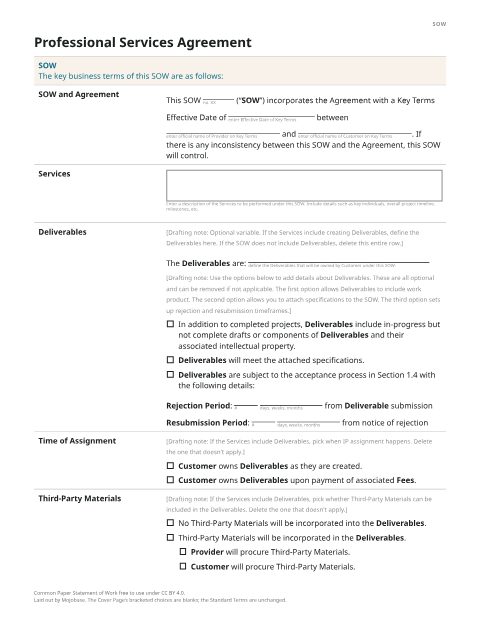
Loading PDF preview…
When should you use a statement of work?
Use it each time you and a client start a new project under a Common Paper professional services agreement you have already signed. The SOW carries the business details; the agreement carries the legal terms.
An agency might sign one per campaign, a consultancy one per engagement, a development shop one per release. Each SOW names the main agreement by its Key Terms date and becomes a separate contract with it; where they conflict, the SOW wins.
Words like Rejection Period and Third-Party Materials get their meaning from the professional services agreement. With no main agreement yet, start with that agreement, whose file includes a first SOW. To hire one freelancer, the independent contractor agreement has its own one-page SOW.
What does this statement of work cover?
Two cover pages, row by row, with the provider and customer signing at the end. The rows, in order:
- SOW and Agreement
- Links this SOW to the main agreement by its Key Terms Effective Date and the parties' names, and says this SOW controls if the two disagree.
- Services
- What the provider will do: key people, the overall timeline and milestones.
- Deliverables
- Optional. What the customer will own at the end. Three add-ons: drafts and work in progress count too; the work must meet attached specifications; and the customer gets a window to reject a deliverable, after which the provider has a window to fix and resubmit it.
- Time of Assignment
- When ownership of the deliverables passes to the customer: as each one is created, or once its fees are paid.
- Third-Party Materials
- Whether outside material, such as licensed fonts, stock images or code libraries, can go into the deliverables, and if so whether the provider or the customer gets it.
- Fees and travel
- How the work is priced (hourly, per project, per milestone), any pass-through charges such as tooling or third-party license fees, and an optional travel and expense policy.
- Payment Period and Invoice Period
- How long the customer has to pay each invoice, and how often the provider sends one.
- SOW Date and SOW Term
- When the project starts (the last signature or a date you set) and when it ends (after a set length or on a set date).
- Customer Obligations
- What the customer has to do for the work to happen, such as naming one point of contact or limiting where the deliverables are used.
- Other Changes to Standard Terms
- Changes to the main agreement that apply to this project alone. Changes meant for every project belong in the agreement's Key Terms instead.
How do you fill in the statement of work?
Optional rows you leave empty simply don't apply. Required are the two names, the services, the fees and the payment period.
- SOW number and main agreement's date
- A number to tell this SOW apart from others under the same agreement, and the effective date written on that agreement's Key Terms.
- Provider's and customer's legal names
- The official names exactly as they appear on the Key Terms, so the SOW clearly attaches to that agreement.
- Services for this project, and deliverables
- The work in enough detail to plan against, then the specific outputs the customer will own. Deliverables can stay empty for advice or hours of work.
- Acceptance boxes and periods
- Tick the add-ons you want. If deliverables can be rejected, set the time to reject from submission and the time to fix and resubmit from the rejection notice, as a number plus days, weeks or months.
- Ownership and third-party materials
- Pick one ownership timing. Then pick no third-party materials, or allow them and say who gets the licenses.
- Fees, payment and invoices
- Describe the pricing, tick travel and expenses only if billed, then a payment window (the form's example is 30 days from receipt of invoice) and an invoicing rhythm, such as monthly.
- Start and end
- The project starts on the last signature unless you tick a set date. It ends after a set length unless you pick an end date.
- What the customer must do, and changes
- Customer duties in plain terms, and any project-only change to the main agreement's terms.
Which documents go with a statement of work?
A statement of work always sits under a main agreement. These surround it.
- Professional services agreement (MSA)
- The main agreement this SOW attaches to, signed once with the client before the first project.
- Independent contractor agreement
- For hiring one freelancer yourself; it carries its own short SOW and terms in a single document.
- Data processing agreement
- When the project means handling personal data for the customer; the main agreement points to it.
- Contract amendment
- For changing signed terms that a change order to this SOW can't reach.
What else do people ask?
What is the difference between an SOW and an MSA?
The master agreement, here the professional services agreement, holds the legal terms that stay the same across projects: liability, indemnity, confidentiality, insurance, governing law. A statement of work holds one project's business terms: what gets done, what gets delivered, the price and the dates. You sign the master agreement once and a new SOW for each project, and each SOW plus the master agreement forms its own contract.
Can this SOW be used without a master agreement?
It is written to sit under one. Its first row incorporates an agreement identified by a Key Terms Effective Date, and it relies on that agreement's section 1.4 for acceptance and on its definitions for terms like Deliverables and Third-Party Materials. On its own it states the work and the price but leaves the legal terms, such as liability and confidentiality, undefined.
What happens if the SOW and the master agreement disagree?
The SOW wins. Its opening row says that if there is any inconsistency between the SOW and the agreement, the SOW controls. The Other Changes to Standard Terms row puts that to use: a change written there, such as fees billed in a currency other than U.S. Dollars, applies to this project only and leaves the agreement as it is for every other SOW.
When does the customer own the deliverables?
At the Time of Assignment you choose in the SOW: either as each deliverable is created, or once the customer pays the fees tied to it. Until then the provider holds the rights. Either way, material the provider owned before the project and third-party materials stay outside the transfer; the master agreement gives the customer a license to the provider's existing material so it can use the deliverables.
How do you change an SOW after it's signed?
Through a change order under the professional services agreement. Either side can propose one, the other must consider it in good faith and reply within a reasonable time, and it binds no one until both agree in writing. A change order names the SOW being changed and describes what changes, so the original SOW stays on record beside it.