
Pilot agreement template
A pilot agreement lets a customer evaluate your product for a fixed period, at no charge or for a fee, before deciding whether to sign a longer-term deal.
- Common Paper 1.1 · lawyer-written
- Free to use
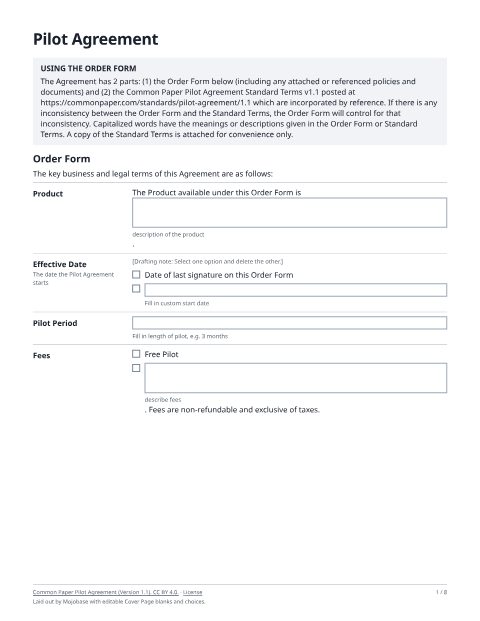
Loading PDF preview…
When should you use a pilot agreement?
Use it when a prospective customer wants to try your product on its own systems or data for a few weeks or months before committing to a subscription or license.
Common cases: a proof of concept for a software buyer, a paid trial with one department before a company-wide rollout, a no-charge evaluation for a large prospect. Common Paper's Pilot Agreement version 1.1, written by attorneys, limits use to testing whether to sign a longer deal.
It is the wrong fit when the customer is shaping an unfinished product in return for feedback (a design partner agreement), or is ready for ongoing use (a cloud service or software license agreement, which this document calls the Definitive Agreement).
What does this pilot agreement cover?
A three-page Order Form with the deal, then eight sections of Standard Terms, in this order.
- Pilot access (1)
- During the pilot the customer may use the product only for internal testing, with a limited license for any installed software. It answers for its users' accounts. The provider uses customer content only to run the product.
- Feedback, usage data and restrictions (1.5, 1.6)
- The provider may use feedback freely and usage data to improve and promote its products, shared only in aggregate. The customer may not reverse engineer, resell, copy or security-test the product, use it to build a competitor, or use it in high-risk settings like air traffic control.
- Term and termination (2)
- It runs through the pilot period. Either side can end it 30 days after notice of an unfixed breach, at once for insolvency, or for any reason on 30 days' notice. With no Definitive Agreement at the end, the customer stops using the product and uninstalls any software, and the provider deletes customer content within 60 days if asked.
- Representations and disclaimer (3, 4)
- Each side confirms it has authority to sign and is in good standing, and nothing more. The product comes as is and as available, with no promise it will be secure, error-free or uninterrupted.
- Limitation of liability (5)
- Each side's total liability stops at the General Cap Amount on the Order Form. Neither owes lost profits or indirect damages, except for confidentiality breaches.
- Confidentiality (6)
- Mutual. Non-public customer content is the customer's confidential information, and non-public product details are the provider's. Either may share with users, staff and advisors who need to know and are bound to the same standard.
- General terms (7)
- Customer purchase order and vendor portal terms don't apply. The provider may assign the agreement in a merger or sale, the customer pays itemized taxes, and force majeure never excuses fees.
- Definitions (8)
- Any variable the Order Form leaves out means "none" and its clause drops out. Product, Software, Users and the Definitive Agreement are defined here.
How do you fill in the pilot agreement?
Required: the product, the pilot length, the governing law, the courts, and both legal names. Leave an optional row empty and its clause doesn't apply.
- Product being piloted
- The product, edition or modules the customer may use during the evaluation.
- Start date and pilot length
- The pilot starts on the last signature, or tick a set date and fill it in. Write the length in words, such as 3 months.
- Paid or no charge
- Tick no charge, or tick paid pilot and describe the fees. Fees are non-refundable and exclude taxes.
- How a paid pilot is paid
- By invoice: the number of days to pay, counted from the customer's receipt of the invoice or from the invoice date. Or automatically: the customer authorizes charges to a card or account monthly, quarterly, yearly, or once per pilot, and the provider makes billing history available.
- Governing law and courts for disputes
- The state, province or country whose law applies, and the place whose courts hear disputes.
- Liability cap
- Pick one: a multiple of the fees paid or payable in the prior 12 months, a dollar figure, or the greater of a dollar figure and a multiple other than 1. With no option filled in, the drafting note says the contract has no limitation of liability. On a no-charge pilot, a multiple of fees paid works out to zero.
- Data processing agreement and technical support
- Attach or say where to find a DPA if personal data is involved, and describe what support comes with the pilot and how to reach it.
- Changes and names
- Any specific changes to the Standard Terms, then the official company names above each signature.
Which documents go with a pilot agreement?
A pilot sits between a first conversation and a signed deal. These come before, beside or after it.
- Design partner agreement
- When the customer helps build an early product and commits to feedback sessions or a case study in return.
- Cloud service agreement
- The usual Definitive Agreement after a successful pilot of hosted software.
- Software license agreement
- The longer-term deal when the customer installs and runs your software itself.
- Data processing agreement
- Referenced from the Order Form when pilot data includes personal information.
- Mutual NDA
- For demos and pricing talks before the pilot starts and its own confidentiality section applies.
What else do people ask?
How is a pilot agreement different from a product trial?
A self-serve trial usually runs on a website's standard terms. A pilot agreement is a signed contract with one customer, setting a named product, a fixed period, optional fees, a liability cap and mutual confidentiality. This one also limits use to evaluating whether to sign a Definitive Agreement, so the customer can't run the product in everyday production under the pilot's terms.
What happens when the pilot ends?
If the parties have signed a Definitive Agreement, that agreement takes over. If not, the customer loses the right to use the product, must uninstall any installed software and certify that it has, and can ask the provider to delete its content, which the provider does within 60 days. Each side returns or destroys the other's confidential information.
Can the customer end a pilot early?
Yes. Either party may end the agreement for any reason or none by giving the other 30 days' notice. It can also end sooner: 30 days after notice of a material breach that hasn't been fixed, or straight away on notice when the breach can't be fixed or the other side stops trading or enters insolvency.
Does the provider promise the product works during the pilot?
No. Section 3 has each side confirm only that it has authority to sign and is in good standing. Section 4 provides the product as is and as available, says there is no guarantee it will be safe, secure or error-free, and disclaims the implied warranties of merchantability and fitness for a particular purpose. Any support commitment goes in the Technical Support row.