Design partner agreement template
A design partner agreement gives an early customer access to a product still in development, in return for regular feedback the provider owns and builds on.
- Common Paper 1.3 · lawyer-written
- Free to use
Loading PDF preview…
When should you use a design partner agreement?
Use it when you are building a product and want a few early customers to use it, tell you what works, and help shape what you build next.
Typical cases: a startup recruiting its first five companies before launch, a team opening a beta of a new module to existing clients, a founder trading a future discount for monthly feedback calls. Common Paper's attorney-written Standard Terms, version 1.3, say the Program exists to improve the product for all the provider's customers.
Choose the pilot agreement when the product is ready and the customer is deciding whether to buy, and a cloud service agreement once the customer subscribes for the long term.
What does this design partner agreement cover?
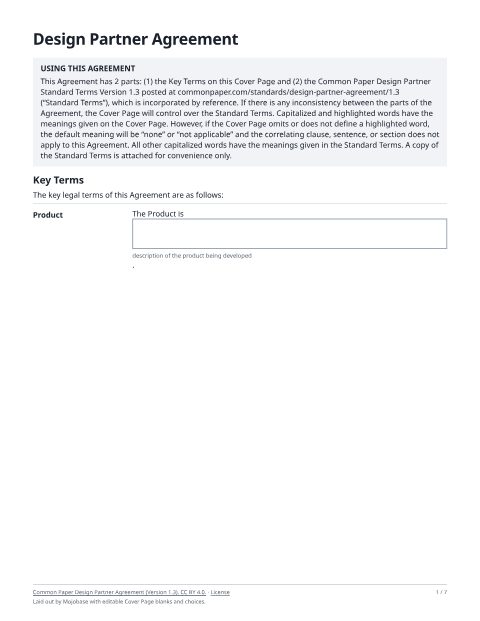
Three Key Terms pages hold the deal, followed by eight short sections of Standard Terms.
- Product and Program (Key Terms)
- The product being developed, and what each side does in the Program: the partner might join feedback sessions, give a case study, appear on customer lists or act as a reference; the provider might give a discount on a later long-term deal or build named features.
- Design partner overview (1)
- The partner gets early access for internal business purposes, gives feedback on an agreed schedule and takes part in the Program. The provider may use all feedback without restriction.
- Fees and term (2, 3)
- The partner pays the fees on the cover page, if any. The agreement starts on the last cover page signature and runs for the term, which the two sides can extend by email. Either side can end it for any reason with 30 days' notice; access and the feedback duty end with it.
- Disclaimer of warranties (4)
- Both sides disclaim all warranties, including merchantability, fitness for a particular purpose and non-infringement, to the extent the law allows.
- Confidentiality (5)
- Mutual, with one twist: the partner's feedback is never its confidential information, and the provider may use the partner's confidential information to provide the product. The agreement's existence and the cover page count as confidential.
- Intellectual property (6)
- The provider keeps all rights in the product, including features built in response to the partner's feedback. The partner assigns all feedback to the provider and helps prove that ownership if needed.
- General terms (7)
- The partner may not reverse engineer, copy, resell or security-test the product or use it to build a competitor. Either side may assign the agreement in a merger or sale.
- Definitions (8)
- Short definitions of the agreement, cover page, confidential information, feedback and product. The Standard Terms have no limitation of liability section and no indemnification.
How do you fill in the design partner agreement?
Required: the product, the term, the governing state, the courts, and both legal names. Program and fee choices are optional ticks.
- Product in development
- What the partner gets early access to, such as the product name and the part being built.
- What the partner does
- Tick each commitment: a number of feedback sessions per month, quarter, year or term; a case study the provider can share; being named in private customer lists or on the provider's website and public lists; serving as a reference; or something else you describe.
- What the provider does
- Tick a discount, as a flat amount or percentage, if the partner later signs a long-term agreement after completing the Program; list product features the provider commits to build; or describe another commitment.
- Term length
- A number of months, quarters or years. The agreement starts on the date of the last cover page signature.
- Governing law and courts for disputes
- A U.S. state, since the cover page reads "the laws of the State of", and the state or county whose state and federal courts hear disputes.
- Fees
- Either a dollar fee per month, quarter, year or term, excluding taxes, paid within a set number of days of receiving the invoice, which the agreement says reflects a discount for the partner's participation; or tick no fees.
- Changes and names
- Any specific changes to the Standard Terms, then each company's official name above its signature.
Which documents go with a design partner agreement?
A design partnership is often the start of a customer relationship. These documents come with or after it.
- Pilot agreement
- For a finished product the customer evaluates before buying, with a liability cap and evaluation-only use.
- Cloud service agreement
- The subscription a partner signs to claim the Program's discount on a long-term deal.
- Mutual NDA
- For early conversations about the roadmap before the partner signs on.
- Software license agreement
- The long-term deal when the product is software the partner installs and runs itself.
- Contract amendment
- To change the Program or fees later in writing, as section 7.2 requires.
What else do people ask?
What is the difference between a design partner and a pilot customer?
A design partner helps shape a product still being built: it gives feedback on a schedule, may join case studies or reference calls, and the provider owns everything that comes out of it. A pilot customer tests a working product to decide whether to buy it. This agreement has no liability cap and no evaluation-only limit, while the pilot agreement has both.
Who owns features built from the partner's feedback?
The provider. Section 6.1 keeps all rights in the product with the provider, including any aspects, features or functionality created in response to feedback or the partner's participation. Section 6.2 goes further: the partner assigns all its rights in the feedback itself to the provider and agrees to cooperate if the provider needs to establish or defend that ownership.
Does a design partner pay?
It's optional. The fees row offers a dollar amount per month, quarter, year or term, in U.S. dollars and excluding taxes, paid within a set number of days of the invoice, and states that the amount reflects a discount for the partner's feedback and participation. The alternative is to tick that there are no fees. A separate Program option promises a discount on a later long-term deal.
Can either side walk away?
Yes, for any reason or no reason, by giving the other side 30 days' notice. When it ends, the partner loses access to the product and no longer owes feedback or Program participation, and each side returns or destroys the other's confidential information. Feedback already given stays the provider's, because the product improvement and intellectual property sections survive.
Can the provider say publicly that the partner is a customer?
Only if the cover page says so. The agreement's existence counts as confidential information, so the Program boxes do the work: one names the partner in private customer lists, another on the provider's website and public customer lists, and a third commits the partner to a case study the provider can share with others. Unticked, none of these apply.