Referral agreement template
Common Paper's Partnership Agreement 1.1 sets the terms when two businesses refer customers to each other, pay for referrals, or promote each other under a brand license.
- Common Paper 1.1 · lawyer-written
- Free to use
Loading PDF preview…
When should you use a referral agreement?
Use it when your business and another agree to send each other customers, pay for referrals, or market together, before anyone shares a lead or a logo.
- Paying for referrals
- Write the criteria a lead must meet to count as a Referral and the amount the other side pays for it, on a schedule you set.
- Co-marketing and sponsorship
- Joint webinars, newsletter swaps or event sponsorships: each side lists the promotional activities, materials and sponsored benefits it provides.
- Using each other's logos
- Ticking the brand box makes a side the Licensor of its names and logos, for the partnership only.
- What it doesn't set up
- Section 12.8 makes the parties independent contractors that can't bind each other, so it creates no agency, reselling or joint venture.
What does this referral agreement cover?
Common Paper titles it the Partnership Agreement. A cover page of Business Terms and Key Terms comes first, then the Standard Terms in thirteen sections.
- 1. Cooperation
- Each side performs the Obligations ticked on the cover page. Feedback is given as is and may be used without restriction.
- 2. Payment & Taxes
- When fees are owed, the side being paid invoices under the Payment Process and the payer pays under the Payment Schedule, in U.S. dollars, along with sales tax or VAT.
- 3. Trademark License
- A non-exclusive, revocable license with no royalty to use the Licensor's brand elements in the Territory, only for the Obligations. The Licensor may approve every use and end it by written notice.
- 4 and 5. Privacy and Escalation Procedure
- A DPA, if signed, controls personal data. Before seeking legal relief, a side gives written notice and both meet within 30 days to settle it.
- 6. Term & Termination
- It runs to the End Date. Either side may end it after a breach left uncured for 30 days, or 5 days for harmful brand use. At the end, brand use stops. After an early termination, the side being paid sends a final bill or refunds unearned prepaid fees.
- 7 and 8. Warranties and disclaimer
- Each side promises its brand elements infringe no one's rights and that it may share any personal data it passes on.
- 9. Limitation of Liability
- A general cap, a higher cap for Increased Claims, and no cap for Unlimited Claims. Confidentiality breaches lose the damages waiver.
- 10 and 11. Indemnification and Confidentiality
- Each side defends the other against its Covered Claims. The agreement's existence and its cover page are confidential.
- 12 and 13. General Terms and Definitions
- Neither side may assign the agreement without consent, with no exception for a merger. Anti-bribery rules and the definitions follow.
How do you fill in the referral agreement?
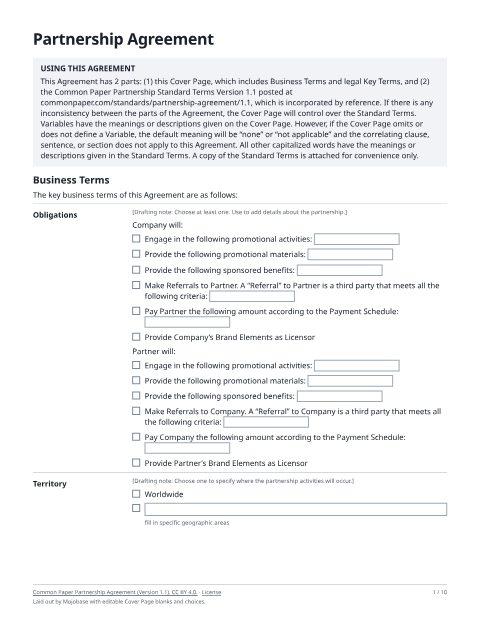
The cover page holds all the blanks. A term left out doesn't apply, as the agreement's opening paragraph explains.
- Obligations
- Choose at least one duty, for either side: activities, materials, sponsored benefits, referrals with their criteria, a payment, or a brand license. Describe each ticked item.
- Territory
- Worldwide, or the areas you name. The brand license applies only there.
- Payment Process and Schedule
- If fees are owed, say where each side sends invoices and when they are paid, such as 30 days from receipt.
- End date and start
- A number of days, weeks, months or years after the start, or a set date; nothing renews. The Effective Date is the last signature unless you fill in another.
- Law, courts and covered claims
- Write the state or country whose law applies and the county or state for the courts, then tick which side indemnifies the other.
- Caps
- Caps work from the fees paid or payable in the 12 months before a claim: a multiple of them, a flat dollar sum, or whichever is greater. With no general cap, liability is unlimited. Then tick the claims that take the higher cap or no cap at all.
- Warranties, DPA and brand guidelines
- Add extra promises from either side, where a DPA is, and where each side's brand guidelines are.
- Changes and names
- List any changes to the Standard Terms, then each side's legal name.
Which related document do you need?
Referral deals often start with an NDA and sometimes need a data agreement or a later change.
- Mutual NDA
- Protects pipeline numbers and customer lists both sides swap before agreeing terms.
- Data processing agreement
- The agreement's DPA row points to one when leads' personal data passes between you.
- Contract amendment
- Extends the End Date or changes a referral fee in writing, as section 12.2 requires.
- Independent contractor agreement
- Fits better when one person is paid to find clients as a service rather than as a partner business.
- Professional services agreement
- Governs the paid work you then do for a customer a partner referred.
What else do people ask?
Is this a referral agreement or a co-marketing agreement?
Both. Common Paper publishes it as the Partnership Agreement, and its Obligations are a menu for each side: promotional activities, promotional materials, sponsored benefits, referrals, payments and a brand license. Tick only referrals and a payment and it works as a referral agreement; tick activities and brand licenses and it becomes a co-marketing deal. The two can be combined.
How is a referral fee set?
In the Obligations. The side that pays ticks "Pay Partner" or "Pay Company" and writes the amount, which can be a flat sum per referral or a formula. The Referral box sets the criteria a lead must meet to count. Fees are in U.S. dollars unless the cover page says otherwise, paid on the Payment Schedule, and the payer covers taxes other than the payee's income tax.
Does the agreement renew?
No. Section 6.1 runs it from the Effective Date until the End Date on the cover page, which is a period after the start or a fixed date. To keep working together after that, the parties change the End Date in writing signed by both, as section 12.2 requires, or sign a new cover page.
Can a partner use the other company's logo?
Only if the Licensor's "Provide Brand Elements" box is ticked. The license covers names, logos and materials provided, only in the Territory and only to perform the Obligations, following any brand guidelines. The Licensor may ask for samples and approve uses. Use that could harm its reputation is a breach the other side has 5 days to fix before termination.