
Form W-9 (2026)
The IRS form a U.S. person or business gives a payer so the payer has the correct taxpayer identification number for 1099s and other information returns.
- IRS Rev. March 2024
- Free to use
Loading PDF preview…
Who asks for a Form W-9, and why?
Anyone who has to file an information return about money they pay you asks for a W-9, so the number they report matches your name. A client paying you as a contractor, a bank opening an interest account and a broker all ask for one.
The form lists the returns it feeds: 1099-NEC for nonemployee pay, 1099-MISC, 1099-INT, 1099-DIV, 1099-B, 1099-K, 1099-S and others. You give the filled form to the requester. It never goes to the IRS.
The W-9 is only for U.S. persons: citizens, resident aliens, and partnerships, corporations, estates and trusts formed in the United States. A foreign individual gives a W-8BEN instead, and a foreign entity uses another form in the W-8 series.
What does each line of the W-9 mean?
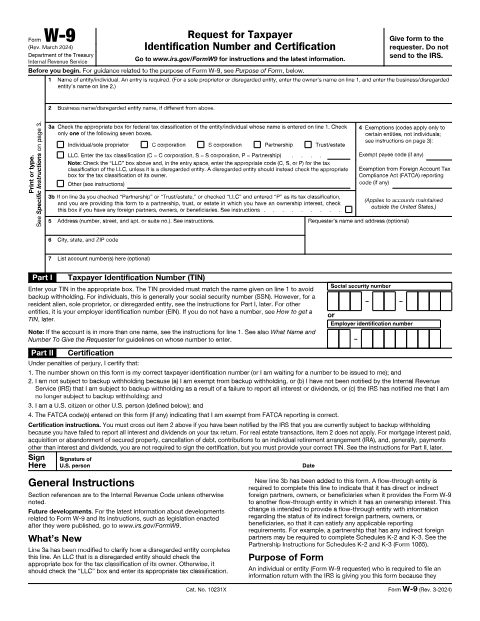
The March 2024 revision has seven numbered lines, then Part I for the number and Part II for the signed certification. Only line 1, the tax classification, the TIN and, when required, the signature are needed every time.
- Line 1, name
- The name on the tax return that reports this income. A sole proprietor or the owner of a disregarded entity puts their own name here, never the business's.
- Line 2, business name
- A trade name, a DBA, or the name of a single-member LLC that's disregarded for tax. Leave it empty if it's the same as line 1.
- Line 3a, tax classification
- One of seven boxes: individual or sole proprietor, C corporation, S corporation, partnership, trust or estate, LLC, or other. An LLC that isn't disregarded checks LLC and writes C, S or P.
- Line 3b, foreign partners
- New in 2024. A partnership, trust or estate checks it when giving the form to a flow-through entity it owns part of and it has any foreign partners, owners or beneficiaries.
- Line 4, exemptions
- An exempt payee code (1 to 13) and a FATCA code (A to M), for certain entities only. Individuals, sole proprietors included, generally have no exempt payee code.
- Lines 5 and 6, address
- Where the requester mails your 1099s. If it's new to them, the instructions say to write NEW at the top of the form.
- Line 7 and requester box
- Optional: account numbers the requester uses for you, and the requester's own name and address.
- Part I, TIN
- A social security number or an employer identification number, in the matching boxes. A resident alien with an ITIN puts it in the SSN boxes.
- Part II, certification
- Four statements signed under penalties of perjury: the number is correct, you aren't subject to backup withholding, you're a U.S. person, and any FATCA code is correct.
How do you fill in and certify the W-9?
Work down the form in order: name, classification, any codes, address, number, then sign and date Part II. The IRS's own Instructions for Form W-9 settle the hard cases.
- Match the name to the number
- The TIN in Part I has to belong to the name on line 1. A mismatch is one of the reasons the IRS gives for backup withholding at 24%.
- Pick one box on line 3a
- Check one box only. A single-member LLC that's disregarded for tax checks the box for its owner's classification. An LLC taxed as a corporation or partnership checks the LLC box and enters C, S or P.
- No number yet
- Write Applied For in the TIN space, sign, and give the form to the requester. The fill-in on this page takes digits only, so write Applied For by hand on your downloaded copy. For interest and dividends you generally then have 60 days to provide the number.
- Cross out item 2 when it applies
- If the IRS has told you that you're currently subject to backup withholding for under-reporting interest or dividends, strike item 2 before signing.
- Sign and date
- The person named on line 1 signs. For many payments other than interest and dividends you don't have to sign, though the requester may still ask you to.
- The official instructions
- Every line's rules, the exemption code lists and the name-and-number table are in the IRS Instructions for Form W-9.
Which related document do you need?
A W-9 usually travels with the paperwork for the work it pays for. These are the documents that sit beside it or replace it.
- Form W-8BEN
- For a foreign individual you pay. It certifies foreign status instead of giving a U.S. number.
- Independent contractor agreement
- The contract with a freelancer whose W-9 you collect before the first invoice is paid.
- Statement of work
- The scope, deliverables and fees for a project, alongside the contract and the W-9.
- How to fill out a W-9
- A longer walk through every box, with examples for sole proprietors, LLCs and corporations.
Read the official IRS instructions for Form W-9
What else do people ask?
Do I send my W-9 to the IRS?
No. The top of the form says to give it to the requester and not to send it to the IRS. The requester keeps it on file and uses your name and number when they file a 1099 or another information return about what they paid you. Send it to them through a channel you trust, since it carries your SSN or EIN.
Is the W-9 the same in 2026?
Yes. The current Form W-9 is still the revision dated March 2024, which added line 3b for flow-through entities with foreign owners and clarified how a disregarded entity completes line 3a. There's no separate 2026 edition. Check irs.gov/FormW9 for any later change before you file a requester's copy.
Should a sole proprietor use an SSN or an EIN?
Either. The instructions say a sole proprietor with an EIN may enter the SSN or the EIN, and the IRS encourages the SSN. Whichever you choose, line 1 shows your own name as it appears on your Form 1040, and any business or DBA name goes on line 2.
What happens if I don't return a W-9?
The payer may have to apply backup withholding, keeping 24% of reportable payments and sending it to the IRS. The form also lists a $50 penalty for each failure to give a correct TIN, unless the failure has reasonable cause, and a $500 civil penalty for a false statement that avoids backup withholding.
When do I need to give a new W-9?
When your name or TIN changes for the account, or when you claimed to be an exempt payee and no longer are. The form's own example is a C corporation that elects to become an S corporation. If the grantor of a grantor trust dies, the trust's name or number changes and a new form is due too.