
Form W-8BEN
The IRS form a foreign individual gives a U.S. payer to show they aren't a U.S. person and, where a tax treaty applies, to claim a lower withholding rate.
- IRS Rev. October 2021
- Free to use
Loading PDF preview…
Who asks for a Form W-8BEN, and why?
A U.S. company or financial institution that pays a foreign individual asks for a W-8BEN before paying. Without it, the payer may have to withhold 30% of U.S.-source income such as royalties, interest, dividends or pay for services.
A U.S. client paying an overseas freelancer, a U.S. platform paying royalties to a writer abroad, and a U.S. bank or broker holding a foreign person's account all ask for it. It goes to the payer, never to the IRS.
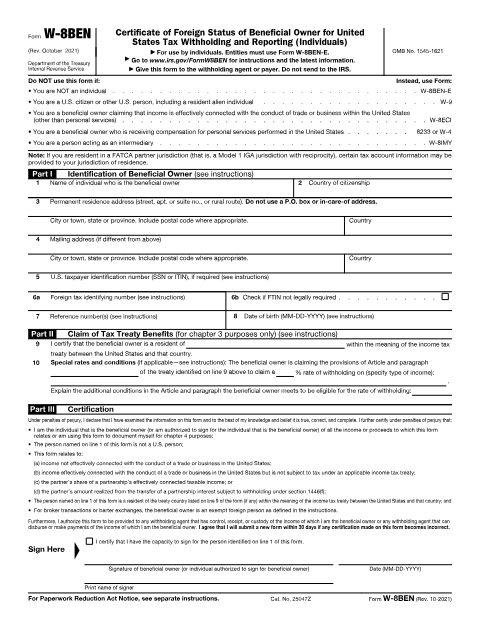
The form's own top lists when to use another one. A business or other entity uses Form W-8BEN-E. A U.S. citizen or resident alien uses Form W-9, even with a second citizenship. Income effectively connected with a U.S. trade or business, including such income allocated through a partnership, goes on W-8ECI. An individual claiming an exemption from withholding on pay for personal services performed in the United States uses Form 8233 or W-4, and an intermediary uses W-8IMY.
What does each line of the W-8BEN mean?
The October 2021 revision has three parts: Part I identifies you, Part II claims treaty benefits, and Part III is the signed certification. Lines 1 to 3 always need filling in; the rest depend on your situation.
- Line 1, name
- Your name as the individual who beneficially owns the income. A foreign single owner of a disregarded entity uses their own name here.
- Line 2, country of citizenship
- A dual citizen enters the country where they are both a citizen and a resident when signing.
- Line 3, permanent residence address
- The address in the country where you're resident for income tax. The form rules out a P.O. box or an in-care-of address.
- Line 4, mailing address
- Only if it differs from line 3.
- Line 5, U.S. TIN
- An SSN or ITIN, if required. Claiming certain treaty benefits needs either this or the foreign number on line 6a.
- Lines 6a and 6b, foreign tax ID
- The tax number your country of residence issued you. Line 6b is a tick box for an account holder whose country doesn't legally require one.
- Line 7, reference numbers
- Optional: an account number, or a reference the payer asks you to include.
- Line 8, date of birth
- Written MM-DD-YYYY. The instructions require it when you document a financial account held at a U.S. office of a financial institution.
- Line 9, treaty country
- The country you claim residence in under its income tax treaty with the United States.
- Line 10, special rates and conditions
- The treaty article and paragraph, the rate claimed, the type of income, and any extra conditions the article requires you to meet.
- Part III, certification
- You certify under penalties of perjury that you're the beneficial owner, not a U.S. person, and resident in the line 9 country, and agree to submit a new form within 30 days if anything becomes incorrect.
How do you fill in and sign the W-8BEN?
Fill in Part I, complete Part II only if you're claiming a treaty rate, then sign, date and print your name in Part III. The IRS Instructions for Form W-8BEN explain each line in full.
- Use your tax residence on line 3
- The instructions say not to give a financial institution's address or one used only for mail. If your country has no street addresses, a descriptive address is allowed.
- Look up the treaty first
- Lines 9 and 10 depend on the treaty between your country and the United States. The IRS keeps the list of tax treaties at IRS.gov/Individuals/International-Taxpayers/Tax-Treaties.
- Line 10 only when the article needs it
- The instructions name examples: royalties with different rates by type, students and researchers, business profits with no U.S. permanent establishment, and remittance-based claims. Most interest and dividend claims leave it empty.
- Sign and date
- The beneficial owner signs, or someone authorized to sign for them, who then confirms that capacity in the tick box. The date is MM-DD-YYYY.
- The official instructions
- The IRS Instructions for Form W-8BEN give line-by-line rules, treaty claim examples and every definition.
Which related document do you need?
The W-8BEN covers tax status only. The work it pays for sits in its own agreement.
- Form W-9
- The form for a U.S. person instead: a citizen, a resident alien, or a business formed in the United States.
- Independent contractor agreement
- Sets out the work and pay for an overseas freelancer, who signs a W-8BEN with it.
- Software license agreement
- For a foreign developer licensing software to a U.S. customer, where royalty treaty rates may come up on line 10.
Read the official IRS instructions for Form W-8BEN
What else do people ask?
How long is a W-8BEN valid?
Generally from the day you sign it until the last day of the third calendar year after that, so a form signed in 2026 lasts through December 31, 2029. A change in circumstances that makes anything on it incorrect ends it sooner: you then tell the payer within 30 days and give a new form.
Do I need a U.S. tax number to fill in a W-8BEN?
Usually not. Line 5 asks for an SSN or ITIN only if required. To claim most treaty benefits you can give either a U.S. number on line 5 or the foreign tax number from your country of residence on line 6a. The instructions list cases where a U.S. number is needed, such as a partner in a U.S. partnership.
Can a company use Form W-8BEN?
No. The form's heading says it's for use by individuals and that entities must use Form W-8BEN-E. That includes a foreign corporation, partnership or LLC receiving the payment in its own name. A foreign individual who solely owns a disregarded entity still uses the W-8BEN, with their own name on line 1.
What happens if I move after submitting it?
Moving to a U.S. address is a change in circumstances, and so is moving out of the country where you claim treaty benefits. Either way you notify the payer within 30 days and give a new form. A move within the same foreign country, or to another foreign country when you claim no treaty rate, generally isn't a change.
Where do I send the W-8BEN?
To the person asking for it, usually whoever pays you or holds your account, before the payment is made. The IRS doesn't take the form itself. The payer keeps it to support the withholding rate it applies and the Form 1042-S it may issue to you.