
One-way NDA template
A unilateral non-disclosure agreement: the Discloser shares confidential information, and the Recipient signs to use it only for the stated purpose and keep it secret.
Preview all 3 pages ›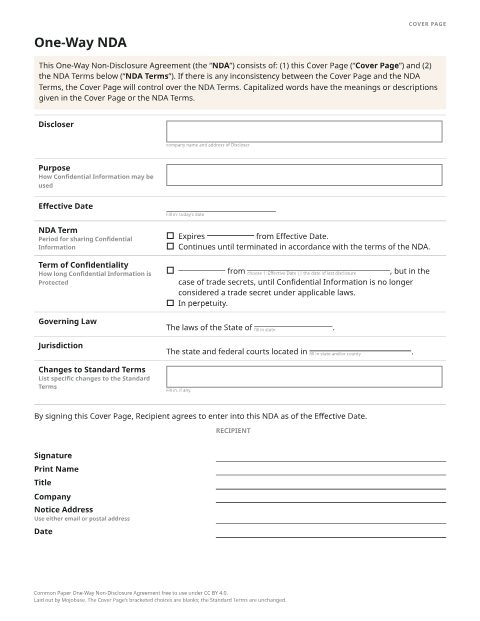
Loading PDF preview…
When should you use a one-way NDA?
Use a one-way NDA when information moves in a single direction: your side is about to reveal something private, and the other side has nothing confidential to give back.
- Demos and pitches
- Showing an unreleased product, designs or internal figures to a possible customer, buyer or supplier.
- Briefing someone before you hire them
- Giving a freelancer, agency or consultant enough detail about a project to quote for it.
- A single signature
- Only the Recipient signs. The Discloser is named, with its address, in the first box of the Cover Page.
- When both sides will share
- If the other party will also hand over its own secrets, a mutual NDA puts the same duties on both of you.
What does this one-way NDA cover?
A Cover Page holds the names and choices, and eleven NDA Terms follow it. If the Cover Page and the NDA Terms disagree, the Cover Page controls.
- 1. Introduction
- Confidential Information means what the Discloser marks as confidential or proprietary, plus anything that should reasonably be understood that way. Roadmaps, requirements, pricing and compliance documents are named, and so is the existence of the talks.
- 2. Use and Protection of Confidential Information
- The Recipient may use the information for the Purpose alone and pass it only to representatives with a real need to know who are bound by equally strict secrecy. It answers for them, and its care must be at least reasonable.
- 3. Exceptions
- The Recipient owes nothing for information it can show was public without its fault, already known to it, received from a third party free of restrictions, or built independently without the Discloser's material.
- 4. Disclosures Required by Law
- If a law, subpoena or court order demands the information, the Recipient may hand it over after reasonable notice to the Discloser where permitted, and cooperates, at the Discloser's expense, in keeping it confidential.
- 5. Term and Termination
- The NDA runs from the Effective Date to the end of the NDA Term. The Discloser alone can cut it short with written notice. The Recipient's duties continue for the Term of Confidentiality.
- 6. Return or Destruction of Confidential Information
- When the NDA ends, or earlier if the Discloser asks, the Recipient stops using the information and, on written request, destroys or returns it. Copies held under backup or record policies stay under the NDA.
- 7. Proprietary Rights
- The Discloser keeps all its intellectual property, and sharing gives the Recipient no license.
- 8. Disclaimer
- The Discloser makes no promises about the information, which comes as is and with all faults.
- 9. Governing Law and Jurisdiction
- The law of the state written on the Cover Page governs, and only the federal or state courts in the named place may hear a case.
- 10. Equitable Relief
- If the Recipient breaches the NDA, the Discloser can seek an injunction on top of other remedies.
- 11. General
- The Discloser has no duty to share anything or go ahead with any deal, and only the Discloser may assign the NDA without consent, in a merger or sale of the business. Amendments need both parties' signatures.
How do you fill in the one-way NDA?
All the blanks are on the Cover Page, and the NDA Terms stay unchanged. The Recipient completes its own details when it signs.
- Discloser's name and address
- The company sharing the information: its legal name and address.
- What it may be used for
- The Purpose. It's prefilled with evaluating whether to enter into a business relationship with the other party; replacing it with a specific project or decision limits use to that.
- Starts on
- The Effective Date, set to today unless you change it.
- NDA ends after a set time, or runs until the Discloser ends it
- This sets the NDA Term, the period for sharing information. A set time starts at the Effective Date, with its length in NDA lasts (1 year is filled in). The other choice runs until the Discloser gives notice.
- How long secrecy lasts
- Choose a set time or in perpetuity. With a set time, write its length in Kept secret for, and in Counted from say whether it starts at the Effective Date or at the last disclosure. Trade secrets stay protected for as long as they legally remain trade secrets.
- Governing law (state)
- One US state, written by name.
- Courts (state or county)
- The place whose state and federal courts take any case under the NDA, as a state, a county, or both.
- Changes to the NDA terms
- Any specific change to the NDA Terms. Empty means none.
- Recipient's signature block
- The Recipient signs and adds a printed name, title, company, notice address (email or postal) and the date.
Which related document do you need?
A one-way NDA protects a first conversation. What comes next depends on who the other side is.
- Mutual NDA
- Choose it instead when the other side will share confidential material too.
- Independent contractor agreement
- When the person you briefed becomes a freelancer working for you, this sets out their services and pay.
- Contract amendment
- To change a term once the NDA is signed, since the NDA needs a signed writing for any change.
What else do people ask?
What is the difference between a one-way and a mutual NDA?
In a one-way NDA, one party discloses and the other promises to keep the information confidential. In a mutual NDA, both parties disclose and both make that promise. This one-way version also gives the Discloser alone the right to end the NDA early, and only the Recipient signs the Cover Page.
Why does only the recipient sign a one-way NDA?
The duties in this NDA fall on the Recipient: using the information only for the Purpose, protecting it and returning or destroying it. The Cover Page says that by signing, the Recipient agrees to enter into the NDA as of the Effective Date. The Discloser is identified by name and address in the first box instead.
Who can end a one-way NDA?
Under Section 5, the Discloser can terminate this NDA whenever it likes, with or without a reason, by notifying the Recipient in writing. Otherwise it ends at the close of the NDA Term chosen on the Cover Page. Either way, the Recipient must keep protecting what it received for the Term of Confidentiality.
What information isn't protected by the NDA?
Section 3 lists four exceptions. The Recipient's duties don't reach information it can show became public without its fault, that it rightfully had before the Discloser shared it, that someone else gave it with no strings attached, or that it developed independently without using or referring to the Discloser's information.