
Employee IP agreement template
An intellectual property assignment agreement that gives the company the IP an employee creates within the job and leaves their personal projects with them.
Preview all 2 pages ›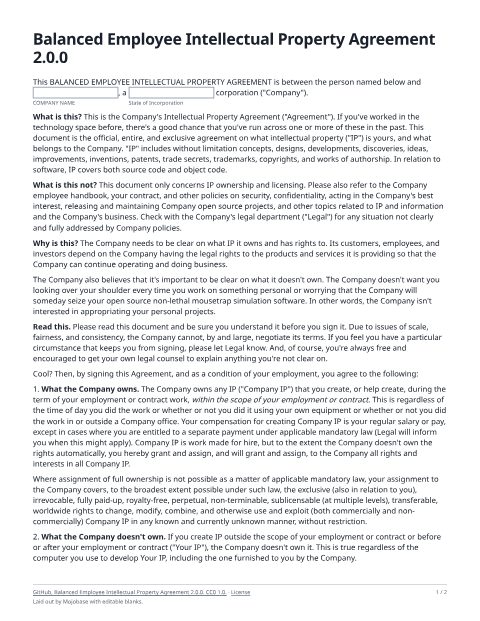
Loading PDF preview…
When should you use an employee IP agreement?
Use it when someone joins to build things for the company, so that what they make in the role clearly belongs to the company and what they make on their own clearly doesn't.
- Hiring engineers, designers or writers
- Anyone whose work produces code, designs, inventions or written material. The agreement covers source code and object code explicitly.
- Contract work too
- The wording covers both employment and contract work, so the same ownership terms can apply to a contractor.
- People with open source or side projects
- Section 2 keeps IP made outside the scope of the job with the person, even on a company laptop.
- Confidentiality is a separate matter
- The agreement says it concerns IP ownership and licensing only, and points to other policies for confidentiality and security.
- Not a corporation
- The opening describes the company as a corporation of the state you name. An LLC or partnership would need that wording changed.
What does this employee IP agreement cover?
It opens with four short explanations in plain language, then eight numbered sections. The employee signs it as a condition of employment.
- What is this, what is this not, why is this, read this
- IP is defined broadly, from ideas and inventions to trademarks and copyrights. The company says it can't usually negotiate the terms, asks people to tell Legal about special circumstances, and encourages them to get their own counsel.
- 1. What the Company owns
- IP the person creates during their employment or contract and within its scope is Company IP, whatever the time of day or equipment. Pay is their regular salary, unless mandatory law gives a separate payment. It's work made for hire, with an assignment as backup and a broad exclusive license where full assignment isn't possible.
- 2. What the Company doesn't own
- IP made outside the job's scope, or before or after it, is Your IP, even if made on a company computer. IP that employment law excludes is also left out.
- 3. License to the Company for Your IP
- The person keeps Your IP but gives the company a non-exclusive, perpetual, royalty-free license in two cases: they know of its use in company work and agree or don't object, or they made it during the job and it relates to the company's business or research.
- 4. Check with Legal on using non-Company IP
- Legal decides whether a license, such as an open source one, is enough for the company to rely on, and the person follows company policy on it.
- 5. Check with Legal on your contributions to non-Company projects
- Before submitting company IP to an outside project or signing a contribution agreement, the person tells Legal.
- 6. No conflicts
- The person confirms no other agreement conflicts, won't sign one later, and won't bring others' confidential material to the company.
- 7. Cooperation
- The person keeps development records, provides them on request, appoints the company as attorney-in-fact to secure rights, and helps defend them after leaving, paid at a reasonable rate.
- 8. Survivorship
- If a court or agency finds a term invalid, the rest of the agreement stays in force.
How do you fill in the employee IP agreement?
The company fills in two blanks in the first sentence. The employee does the rest at the end.
- Company's legal name
- The company's full registered name. The agreement calls it the Company throughout.
- State of incorporation
- The state where the company is incorporated, such as Delaware. It completes the phrase describing the company as a corporation of that state.
- Employee's signature
- The employee prints their name, signs and dates it. There's no signature line for the company.
Which related document do you need?
This agreement covers ownership of work. Other documents handle the job itself and confidentiality.
- Independent contractor agreement
- For a freelancer, it sets out the services, pay and how you work together.
- One-way NDA
- When you need someone outside the company to keep your information secret.
- Software license agreement
- When the company licenses its own software to a customer.
What else do people ask?
What is an employee IP agreement?
An employee IP agreement, also called an intellectual property assignment agreement, decides who owns what a person creates while working for a company. Under this one, the company owns IP created during the job and within its scope, and the person keeps IP created outside that scope or before or after the job, subject to a license in certain cases.
Does the company own my side projects under this agreement?
Not if they're outside the scope of the job, or made before or after it, even on a company computer. Section 3 gives the company a non-exclusive license to such work if you know it's used in company work and don't object, or if you made it during the job and it relates to the company's business or research.
Why is it called balanced?
GitHub published it to be clear about what the company doesn't own as well as what it does. The text says the company doesn't want people looking over their shoulder when working on something personal and isn't interested in appropriating personal projects. GitHub released version 2.0.0 under CC0 1.0, so anyone may use and change it.
Does this agreement cover confidentiality?
No. Its opening says it only concerns IP ownership and licensing, and refers to the employee handbook, the employment contract and other company policies for security, confidentiality and related topics. Section 6 does require the person not to bring to the company anything they must keep confidential for someone else, and to honor earlier non-disclosure agreements.
Will the employee be paid for helping after they leave?
Yes. Section 7 asks the person to keep records of how Company IP was developed and to help the company secure or defend its rights, including after they leave. For help after leaving, the company pays them at a reasonable rate. During employment, their regular salary or pay is the compensation for Company IP.